
Cool AI with the water people have already used.
Use a city's sewage, not its drinking water, as the heat sink for AI data centers. Warmer sewage helps the treatment plant, the data center stops competing for fresh water, and AI infrastructure comes to depend on people going about their ordinary lives.
Patent pending
New global research: data centers and wastewater plants belong together
In 2026 a team led by Harbin Institute of Technology, with co-authors at KWR Water Research Institute, the University of Exeter and the University of Michigan, published the first global assessment of pairing data centers with municipal wastewater treatment plants. They mapped 4,775 data centers and 57,547 treatment plants in 98 countries, then modeled pairings in which treated effluent cools the data center and the data center's heat goes back to the plant.
What the study found. Data centers and treatment plants sit much closer together than chance would predict, and wastewater plants could meet nearly all of the cooling demand of the data centers studied. Most of the plants (83.5%) are in places where the annual average temperature is below 20 °C. In a simulated pairing in Shenzhen, returning data center heat to the plant cut sludge-drying energy by 22.7% and raised methane production by 6.8%, and the authors note that the slight temperature rise may help biological treatment.
The authors conclude that wastewater plants are poised to evolve from disposal facilities into critical energy-coupling hubs, and that policies encouraging co-location of data centers and treatment plants could be a cost-effective route to climate and water goals.
Wang A., Zhang C., Xu T., Savic D., Jiang J., Xiao P., He C., Tao Y., Daigger G., Ren N. (2026). Global data–water symbiosis reduces AI infrastructure's carbon and water footprint. Environmental Science and Ecotechnology 31, 100702. Open access.
EcoVia did not take part in this study, and the authors have not reviewed or endorsed EcoVia's technology. The study treats effluent after tertiary treatment and uses the returned heat mainly for sludge drying and digestion. EcoVia's pending application uses the sewage itself as the heat sink, as described below.
Three problems, one connection
1. Cooling water
Evaporative cooling consumes fresh water. Researchers project that global AI could withdraw 4.2 to 6.6 billion cubic meters of water in 2027. Rejecting the heat to sewage means the data center is not competing for clean fresh water, which removes a common obstacle to siting and building.
2. AI safety
Sewage comes from people flushing toilets, showering, bathing and running sinks. Making it the sole or primary heat sink for a data center creates an obligate dependence of AI infrastructure on continued human activity, a structural disincentive against harming people.
3. Local support
Communities have pushed back on data centers that draw on local drinking water, and lawmakers are responding. A design that answers the water objection from the start gives local officials and residents a better reason to say yes.
How it works
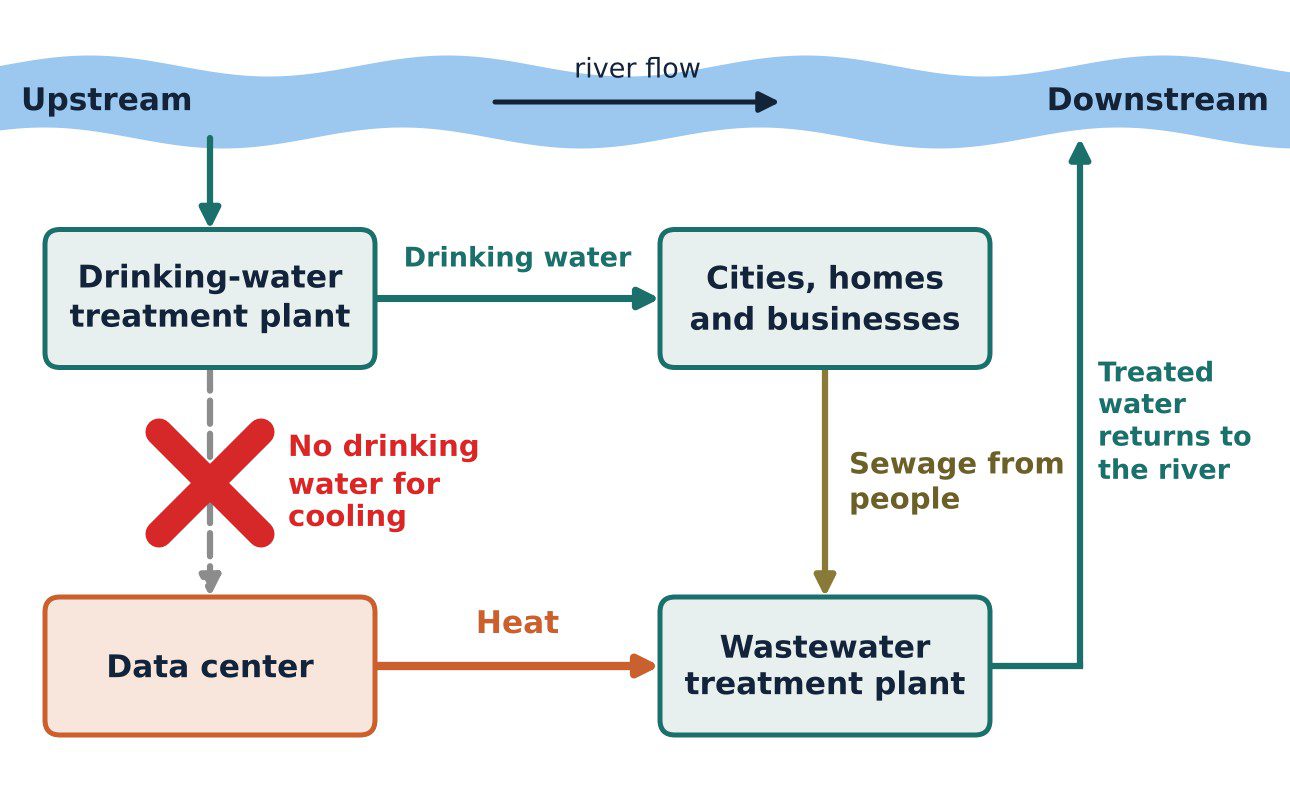
Data centers must be cooled to function. Without cooling, the processors that host AI software overheat and fail. In EcoVia's approach the data center's waste heat passes through a heat exchange system into sewage, and the warmed sewage continues on to treatment.
- Take the sewage where it is cleanest. At a treatment plant, the preferred point is after primary settling. At a lagoon, it is where most settling has already happened. From a sewer line, rocks, rags, plastic and strings are removed first so they cannot clog the heat transfer.
- Transfer the heat. The data center's waste heat goes into the sewage through a heat exchange system, such as the moving bed biofilm reactor (MBBR) based heat exchange described in EcoVia's issued patents.
- Return the warmed flow. At a plant, the warmed sewage goes back to the aeration and anoxic basins, where the biology works faster. At a lagoon it returns to the inlet or to a second-stage lagoon; from a sewer line it returns to the sewer.
- Match the schedules. Data centers and sewers both run 24 hours a day, 365 days a year. Planned outages for hardware upgrades can be scheduled in summer, when the plant least needs the heat.
Better treatment from the same heat. Warmer sewage supports faster biological treatment, especially of nitrogen. Singapore treats its sewage with partial nitritation and anammox (PNA) and reuses the water, which works because its sewage stays warm all year. Colder northern cities cannot use that approach today. Warming their sewage with data center heat could improve treatment in general.
Why sewage, for AI safety
World experts have warned that artificial general intelligence (AGI) could pose an existential threat to humanity. EcoVia proposes one physical safeguard: build AI infrastructure so that it depends on continued human activity.
A reason to keep people well
If human-generated sewage is the sole or primary heat sink for a data center, many people need to keep flushing toilets, taking showers and running sinks for it to keep working. An AI system that harmed people would lose its own cooling. That gives it an existential incentive to keep the human population healthy.
Hard to take over
It would take relatively few robots to seize a data center. It would take a great many to replace the countless homes and people feeding a city's sewer system. The best version uses a sanitary sewer with little groundwater or surface-water inflow, so the flow depends mainly on people.
One more layer, not a guarantee. This is a physical safeguard that sits beside software safeguards, not in place of them. Because it is hard-plumbed infrastructure, it cannot be changed easily, and any change could not be hidden: rerouting a data center’s cooling takes pipes, permits and construction that people can see.
There is no guarantee it will work. But none of today’s software-based approaches appears to be a final or credible deterrent either. Superintelligence is described as potentially smarter than all humans combined, and a system like that could find its way around rules written in software. A dependence built into the plumbing does not rely on the AI choosing to follow a rule.
Two more places to put the heat
Wastewater plants and livestock farms already own land and water that can take low-grade heat. EcoVia has filed applications on both.
Heated solids-drying slabs
Treatment plants dry and compost their solids on large yards, and drying slows in cold, wet weather. Heat from the data center passes through an isolation heat exchanger into a closed loop embedded in a concrete slab, holding the surface at about 35 to 40 °C. In a worked example, heating cuts the active drying area by roughly half: 100 tonnes a day of wet solids need about 3.3 acres instead of 7.4, using about 1.6 MW of heat, about 1% of the heat from a data center with 150 MW of computing load. The land released can be used for something else, including a data center.
Livestock wastewater lagoons
Swine and dairy lagoons can cover tens to hundreds of acres. A self-cleaning heat exchanger, in which moving carrier media keep the heat transfer surface clean, moves data center heat into the lagoon without mixing, and the lagoon surface releases it to the air. An automatic self-cleaning filter removes chunks first. Sprays run only when the surface alone cannot shed the heat, so in cold weather they can stay off.
Figures are planning estimates from the applications, not measured results. Neither approach has been demonstrated at scale.
Patents
Issued: the heat exchange and treatment technology
EcoVia's founder holds issued patents on heat transfer to sewage and heated biological treatment.
Proven technology, implemented in Missouri and Iowa.
U.S. 8,197,689; 8,361,319; 8,524,084
European Patent 2,588,419 B1
Patent pending: the data center connections
Three U.S. provisional applications cover using human-generated sewage as the sole or primary heat sink for AI data center cooling, heating wastewater-solids drying slabs with data center heat, and rejecting data center heat to livestock lagoons.
64/158,951 sewage heat sink (Sept. 21, 2026)
64/181,836 heated drying slab (Oct. 22, 2026)
64/181,855 lagoon heat rejection (Oct. 22, 2026)
EcoVia supplies heat exchangers and biological treatment systems to municipal wastewater plants, and is looking for utility, engineering and data center partners to examine specific sites.
Talk to us about a site
Do you run a treatment plant, design one, or build or operate a data center? We would like to see whether the numbers work at your site.
Alexander Fassbender, EcoVia Corporation
Patent pending. U.S. provisional applications 64/158,951, 64/181,836 and 64/181,855. Issued patents: U.S. 8,197,689; 8,361,319; 8,524,084; European Patent 2,588,419 B1.
This page describes concepts and patent applications at an early stage. It is not an offer to sell securities or equipment, a design, a performance guarantee or a commitment to any customer, and it is not a statement that any permit or approval will be granted. Statements about benefits to wastewater treatment and to AI safety are proposals that remain to be demonstrated.
Research figures are from Wang et al. (2026), Environmental Science and Ecotechnology 31, 100702, and from Li, Yang, Islam and Ren, "Making AI Less 'Thirsty'," Communications of the ACM 68(7), July 2025. Neither publication's authors have reviewed or endorsed EcoVia or its technology.
© 2026 EcoVia Corporation. All rights reserved.